Recently, the Forage Crop Genetic Improvement team at the Biotechnology Research Institute of the Chinese Academy of Agricultural Sciences discovered a new pathway for haploid induction in Medicago truncatula. The research findings have been published in Plant Biotechnology Journal.
Haploid breeding, which achieves rapid homozygosity of genetic materials through haploid induction and doubling techniques, significantly accelerates the efficiency of inbred line selection. It is a key foundational technology in agricultural biotechnology breeding. However, the development of haploid induction systems in leguminous plants, including alfalfa, has progressed very slowly.
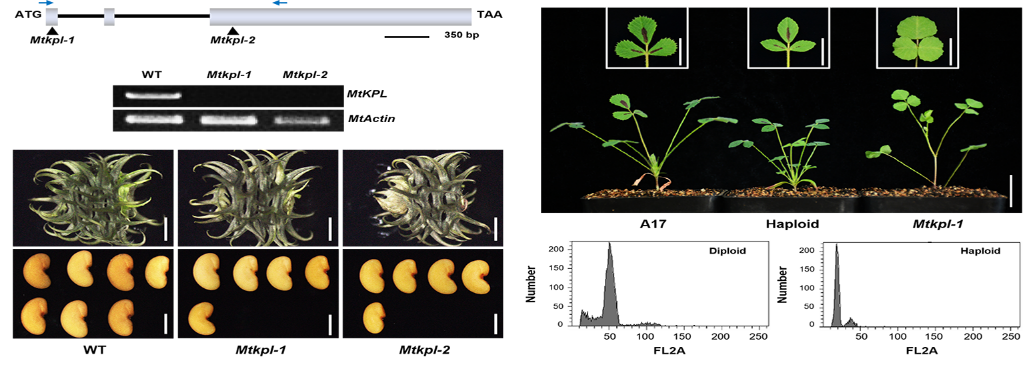
Previous studies have shown that the KPL homologous gene is highly conserved across the plant kingdom and exhibits haploid-inducing capacity. In this study, the researchers identified its homolog in model legume M. truncatula and generated loss-of-function mutants. The study found that haploid plants were produced in both the self-pollinated progeny of the mutants and the cross-pollinated progeny when used as the paternal parent, demonstrating for the first time that deletion of this gene can effectively trigger maternal haploid induction in Medicago. These findings provide a new target and an important foundation for haploid breeding in leguminous plants.
This research was supported by grants from the National Key Research and Development Program of China, the National Natural Science Foundation of China, and other funding sources. (Correspondent: Cui Yan)
Original link: https://onlinelibrary.wiley.com/doi/10.1111/pbi.70628 |