Recently, Baobao Wang’s team from the Biotechnology Research Institute of the Chinese Academy of Agricultural Sciences (CAAS), in joint efforts with Henan Agricultural University and Yazhouwan National Laboratory, has established a new system for genomic precision design breeding of maize ideal plant architecture. This work provides critical theoretical guidance and technical support for the genetic improvement of dense-tolerant and high-yield maize. The related research findings, entitled “Breeding Ideotype Maize with Enhanced Yield Through Genomics-guided Pyramiding of Favorable Alleles”, have been published in Nature Genetics, one of the world’s top academic journals.
As the largest crop in China, increasing unit yield by increasing planting density is an indispensable strategy to safeguard national food security. Nevertheless, the higher planting density has exacerbated prominent problems including heightened lodging risk and reduced population light use efficiency. Developing new maize varieties featuring compact, dense-tolerant and lodging-resistant "ideal plant architecture" has become a core competitive focus for most countries in the global seed industry.
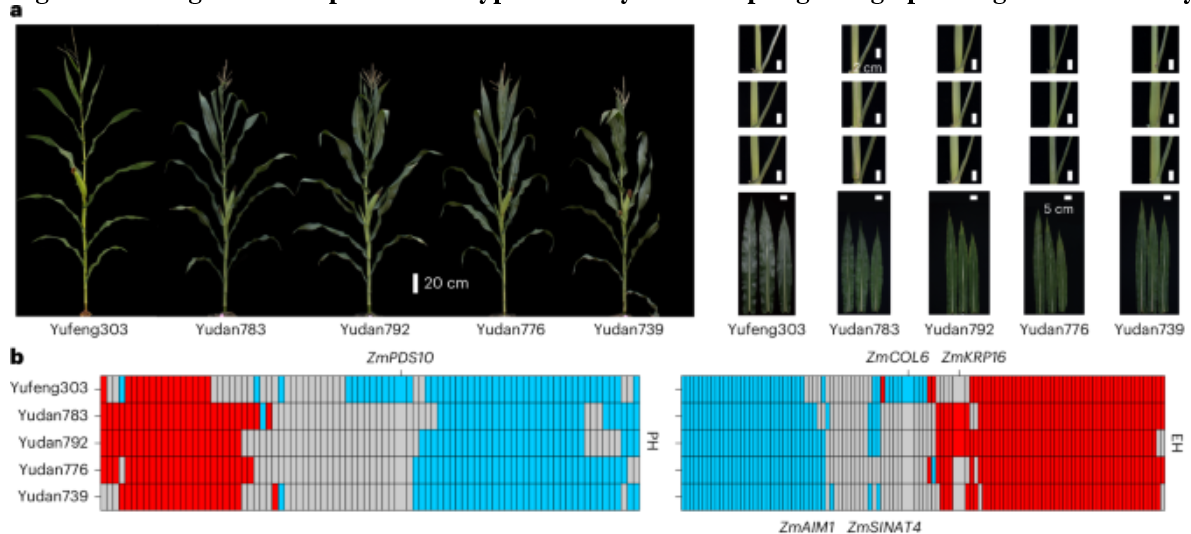
To meet this major national strategic demand, Baobao Wang’s team, in collaboration with partners, conducted years of intensive research. The team systematically deciphered the evolutionary genomic bases of Chinese maize hybrids during modern breeding, successfully identified and cloned multiple key genes regulating maize dense-tolerant plant architecture, and further developed a breeding technology system for "genomics-guided precision design of ideal plant architecture". Leveraging this technology, the team precisely improved classic high-yield maize hybrids that once dominated China’s maize production, cultivating a series of new varieties with significantly enhanced density tolerance and elevated yield.
This study not only unravels the genetic mechanisms underpinning high-yield maize breeding but also marks a transformative leap of China’s maize breeding from traditional "empirical selection" to efficient "precision design". It proves that with genomic big data and modern biotechnology, breeders can abandon the "groping in the dark" approach, and instead design crops with "precision blueprints" and conduct "targeted assembly" just as engineers design machinery. The application of this technology will accelerate the renewal of new maize varieties in China, furnishing robust scientific and technological support for winning the turnaround battle in the seed industry and safeguarding national food security.
This research was funded by the National Key Research and Development Program of China, the National Natural Science Foundation of China and other projects. Professor Chen Yanhui from Henan Agricultural University and Professor Wang Haiyang, Chief Scientist of Yazhouwan National Laboratory, are the co-corresponding authors of the paper. Associate Professor Yao Wen, Professor Ku Lixia from Henan Agricultural University, Wang Baobao from the Biotechnology Research Institute of CAAS, and Associate Professor Ren Zhenzhen from Henan Agricultural University are the co-first authors.
DOI link: https://doi.org/10.1038/s41588-026-02522-0 |